Georgia Employment, Personal Injury, Business Litigation Lawyers

Williams Oinonen LLC helps protect the rights of our clients who have been injured or harmed due to a wrong or injustice. We focus on three central practice areas: personal injury & employment law (helping employees and individuals injured by wrongs), business law (helping small to mid size business owners succeed), and human rights law (helping to uphold the rights of workers, educators, and victims of police misconduct, civil rights abuses and discrimination.) We fight to protect our clients' best interests and help them obtain the justice they deserve. Williams Oinonen LLC cares about each of our clients and we are dedicated to providing them with the legal competence and skill their case requires. The trust and respect we provide each client reflects the commitment we bring to winning their case.

August 22, 2012

Good Georgia Civil Rights Lawyer Discusses Human Rights Violations


mariosuit.jpg

Mario Williams, attorney at Williams Oinonen LLC had one of his civil rights cases recently featured in a news article written by John Rudolf of the Huffington Post.

Mr. Williams represents Terrence Dean, a plaintiff who was subjected to brutal torture and abuse that left him in a coma and disabled in violation of his constitutional civil rights.

Mr. Mario Williams is a human rights attorney and partner at Williams Oinonen LLC. He regularly handles various types of Civil Rights cases under the federal statute 42 U.S.C. Section 1983.

For more information on this news story, please read the feature article highlighted in today's article in the Huffington Post.

August 20, 2012

Good Georgia Education Lawyer Reverses Reduction In Force Part Two:


attorney.JPG

Williams Oinonen LLC was very gratified with the courage the Tribunal showed in making the right decision to reject Superintendent Cheryl Atkinson's recommendation to terminate the contract of an educator in DeKalb County School District through a reduction in force.

While the educator ended up accepting a very attractive offer at a nearby school district so the Tribunal's decision did not end up having to be ruled on by the Board, Ms. Oinonen hopes that the DeKalb County Board of Education will take note as to how the Reduction in Force is being applied, ask the right questions and demand accountability from the Superintendent in the future.

Regarding Ms. Oinonen's legal representation, Mr. Lynch stated:

"She won a RIF hearing for me. That says it all. I cannot recommend Julie enough. She is passionately intense and sincerely dedicated to securing the interests of her client. But, most importantly, she achieved a singular and, in my opinion, far reaching success when she won my RIF hearing, a very difficult thing to do. I would not hesitate to recommend her for any educator in a similar situation."


August 19, 2012

Good Georgia Lawyer Wins Reduction In Force Hearing, Successfully Argues DeKalb County School District Illegally Implementing RIF Plan and Violating Georgia Law (Part One):


tribunal.JPG

In a recent Fair Dismissal Hearing, the Tribunal published its "Findings of Fact and Recommendations to the DeKalb County Board of Education" stating that it "rejects the recommendation to terminate the contract" of a media specialist educator based upon the Reduction in Force plan.

Ms. Oinonen successfully argued that Dekalb County School District's (DCSD's) implementation of the Reduction in Force (RIF) plan is illegal and a violation of the new law, OCGA 20-2-948. This legislation, recently enacted in May 2012 holds it illegal to consider length of service as the primary factor in a RIF. Rather school districts must consider "performance of the educator" as the primary factor in implementing a reduction in force.

Ms. Oinonen argued that this is exactly what DCSD is violating although they denied it--- using a seniority "first in last out system" by claiming that everyone is equal because everyone supposedly has an "overall" satisfactory performance evaluation.

However, under cross examination, the Chief Human Resources officer admitted that DCSD retained people who currently have "Needs Improvements" on their evaluations and who had been on Professional Development Plans ("PDPs") compared to our client with a perfect record.

The Tribunal agreed with Ms. Oinonen's argument and stated in their findings that they "believed that job performance was not fully and properly investigated to differentiate between employees." Additionally, the Tribunal stated the following:

"[T]he Superintendent failed to properly evaluate the final 13 Media Specialists concerning performance, but instead found these 13 to be `equal on performance based solely on an annual evaluation of "satisfactory" without any further review and investigation of these employees. The Tribunal believes it is crucial to further evaluate these employees to weigh and quantify them on performance standards. Failure to do so disregards the intent of OC.G.A. § 20-2-948 which requires the Board to consider performance as the primary factor in implementing a RIF action. Accepting only the annual evaluation of "satisfactory " fails to even minimally comply with this requirement and limits the ability of the District to maintain quality personnel."

The following are two brief excerpts of the cross examination of Dr. Ward Smith, Chief Human Resources Officer during the tribunal hearing and Ms. Oinonen's closing argument:

Excerpt of the Cross Examination of Dr. Ward Smith:

Q. Okay. Now, reminding you that you're under oath, Dr. Ward-Smith, I'd like to ask you would you admit to me that there are some media specialists currently still employed with DeKalb County that have actually been on a PDP at one point in their career?

A. Yes, one point in their career. That is the key phrase.

Q. And would you agree with me that there are some media specialists currently employed with DeKalb County School District that have been on a PDP while as employees of the School District, DeKalb County?

A. I just answered it. Yes.

Q. Well, let me clarify just for the point of the record. I earlier asked would you agree with me that there are currently some media specialists that are still employed with your School District who have been over the course of their entire career in the United States of America have been on a PDP. And I believe you answered yes, correct?

A. Yes. Uh-huh (affirmative).

Q. And now, my second question, just to clarify: Would you also agree with me that there are still media specialists that are going to go back to work this fall who have also been on a PDP while under the auspices of employment within the DeKalb County School District?

A. Yes.

Q. Would you agree with me that Mr. Lynch has never been on a PDP at DeKalb County School District?

A. I cannot confirm, but I would say I don't have information in front of me.

Q. Okay. You don't have the information -- you're saying today under oath that you have no idea whether Mr. Lynch has ever been on a PDP?

A. I'm saying I did not have a PDP for Mr. Lynch.

Q. Okay. And you are also saying, and, again, I'm not trying to be difficult, I just want to understand for the purpose of advocating for my client that you are stating under oath today that you have no knowledge whether he's ever been on a PDP before in his life?

A. I am saying I did not have a PDP for Mr. Lynch.

Q. You don't have one today or you don't --

A. I do not have one --

Q. -- have knowledge?

A. I don't have knowledge of a PDP for Mr. Lynch.

Q. Okay. Thank you. Would you admit, Dr. Ward-Smith, that there are some media specialists that are currently still employed with your School District who have received an NI, needs improvement, on their annual performance evaluations at one point during their career over the past year at DeKalb County School District?

A. Yes, ma'am.

Q. Okay. So there are actually media specialists going back to work this fall who have an NI on their annual performance evaluations?

A. I would say yes, there are.

Q. Okay. And you know that Mr. Lynch has never gotten an NI at DeKalb County School District?

A. Over the last three years, the annual evaluation overall ratings that we reviewed -- and like I say, I can't answer that. But at that particular point, I have no knowledge of Mr. Lynch having an NI.

Q. Okay.

A. Over the last three years.

Q. Do you have any knowledge of Mr. Lynch's annual performance evaluation, period?

A. Yes, ma'am. I have knowledge that it was overall satisfactory.

Q. Okay. Now, let's go back to this RIF evaluation that's now required by Georgia law since May of 2012, regarding considering the primary factor the performance of the educator. So I'd like to talk about this. Now, I think you've already admitted that media specialists -- there's media specialists that are still employed at DeKalb who don't have dual certifications like Mr. Lynch and who have been on Needs Improvement, unlike Mr. Lynch, and who have been on PDPs, unlike Mr. Lynch. So I want to ask you how many media specialists, to your know- -- media specialists, it's like a librarian, right?

A. Library media specialist. Yes, ma'am.

Q. Okay. Okay. So how many library media specialists, to your knowledge, have a 4.0 masters degree in Library Information Sciences?

A. I'm not aware.

Q. Okay. Would you agree that certainly there's probably just a small percentage of them out of the whole 130 folks that you evaluated?

A. I'm not aware of an exact number.

Q. So you don't have that data today that you can show us whether --

A. I do not.

Short Excerpt of Ms. Oinonen's Closing Argument:

"We're 85 million dollars in deficit. But at least, let's do it right. We have enough problems in DeKalb County than screwing up this whole thing and not even complying with Georgia law, and for goodness sake, our own policy, our own policy that our Superintendent and our School Board approved, which states: "The criteria and the evaluation is to be based on professional expertise and certification and performance based upon annual evaluation and seniority only after the aforementioned factors have been considered and found to be equal." That's in addition to the requirement of the law.

And that's why you must reverse this RIF, because they're violating Georgia law. They are not following RIF statute, they are not following their own RIF policy.
But, again, they have the burden of proof to prove that they are. And what did they prove? Did they show us this magical database that I was stammering over when I was trying to think of Dr. Fletcher's excellent question about the rubric? Did they even bring one personnel file to show about these 13 people that were RIF'd? Not once did they present any kind of statistical analysis, did they show us the percentages or any type of formula based on number of satisfactory evaluations to unsatisfactory? No, they didn't do any of that.

But I tell you what they did do. They showed you that something really screwed up is going on. And I say this respectfully, because I think these are all nice people. But why? I can't testify, but I represent educators. And I know what goes on. Why are they keeping people that are on PDP? We all know what that means. Why are keeping people that have a bunch of NI's? You heard her testifying under oath that the people that they kept that didn't RIF, the media specialists, the 130 people that they all said were equal or, you know, were all satisfactory, why were they keeping people that are on current Professional Development Plans or receiving NI rankings and RIFing the people that have absolutely satisfactory evaluations?

This stinks to high Heaven. Something is going on. And it's up to you all to address this issue and to let them know that we understand we're in deficit. We understand we have to RIF people, and it's difficult and it's hard decisions. But when we're going to make these hard decisions, my God, at least let's make them right so they don't end up getting reversed and we end up being in a deeper hole. Let's at least follow our own policy, and let's do it as educators.

We're educators. My God. We've trained on how to do these things. I mean, isn't that what we taught constantly as educators, about learning assessments and evaluations, and we can't even evaluate our own properly? There's something that's going on here. And I'm asking you today to address it and nip this in the bud, because if they're doing this to media specialists, then what are they going to do with the teachers?

Think about that when that comes down the pipe, when 250 teachers get passed, and the Board recommends that they're laid off. Is this how they're going to evaluate? If you don't say something now, they're going to do it to all the teachers in the DeKalb County School District. They're going to RIF the people with satisfactory evaluations, and they're going to keep the people on PDP and with NI's in their record. And what outcome for results is that going to be to the children of DeKalb County? Think about that.

The School District failed to meet their burden of proof. I did not see one chart. I did not see one graph. I did not see one personnel file, which by the way, is subject to the Opens Records Act, and if they were concerned about confidentiality, they could have redacted some names. I didn't see any of that. I didn't see anything, anything, not one single document that really analyzed the criteria according to who should be RIF'd and who shouldn't.

All I heard was Dr. Ward-Smith say a quote that I wrote down to be sure I quoted. She used four words, all things are equal. No, they're not. They're not. They're not following. They're not doing what they're supposed to do. They're not complying with RIF policy, and they're not complying with Georgia law.

I'm not asking you to please play favorites on Mr. Lynch. I'm asking you to do the right thing. I'm asking you to do the right thing that he is afforded as a Georgia educator under O.C.G.A. 20-2-940, and I'm asking you to do the right thing regarding Georgia law concerning the reduction in force and concerning our own School District policy.
You've seen his résumé. And you all know whether this is average or not, a 4.0 Master's degree, Honor's Dean List from UGA, Community Service, Obama Organizing Fellow, English Honor's Society Member, Delta Epsilon Iota Honor's Society Member, UGA Honor's Program Member.

The only reason I -- the only thing that I didn't do that I probably should, I mean, I should have asked Mr. Lynch how much he loves teaching. But I didn't talk about -- I didn't ask him about how much he loved the students. So I can't really go into that, because I didn't present it as evidence, and I wish I had.

But I'm asking you to reverse his RIF. I know it's a big thing, but it's the right thing to do. And if it doesn't get done, and if we just rubber stamp this decision, mark my word, they're not going to just do it to Mr. Lynch, they're going to do it to every teacher. Mark my words, you're going to send a message today. And I just ask you to send the right one. And I ask you sincerely to think carefully what I said and to review all the evidence, and to reverse Mr. Lynch's reduction in force and termination."

August 1, 2012

Williams Oinonen LLC Congratulations Our Political Clients Recent Primary Election Campaign Wins


Mario Williams and Julie Oinonen congratulate our clients' Congressman John Lewis, CEO of DeKalb County Burrell Ellis, and Senator Hortensia Tate in their recent primary election wins on July 31st.

Williams Oinonen LLC provides opponent research and political campaign strategy to national, state and locally elected officials each election season. For more information on what we do, please read:
our article here.

If you are involved in a high stakes election campaign and are looking to win, call us today at 404-654-0288.

July 15, 2012

Good Georgia Lawyer Saves Educator's Job, Reverses Non-Renewal:


principal.JPG

Good Georgia Lawyer was pleased to save an Assistant Principal's job in one of the largest school district's in Georgia.

Regarding Julie Oinonen, attorney at Williams Oinonen LLC, the Assistant Principal stated the following:

"First and foremost Julie was honest & attentive with me from our first meeting concerning my case. In addition, she was easily accessible by phone or e-mail throughout the duration of my case. She is a true professional. In the end, she protected my name, reputation, and secured my contract for the upcoming school year. Thanks!!!"

Good Georgia Lawyer handles all types of education and employment cases representing teachers, administrators, students and parents. We are Georgia Association of Educators (GAE) and National Educators Association (NEA) referring attorneys.

If you are an educator who is placed on a PDP or is experiencing difficulty from your supervisor, the time to seek legal counsel is sooner rather then later in order to protect your job. Seeing an attorney before you are terminated, demoted, or suspended can be key to helping you best insure your legal interests in order to protect your job.

For more information on resolving a dispute concerning education or employment, contact Williams Oinonen LLC at 404-654-0288.

June 19, 2012

Good Georgia Education Lawyer Sues School District For Repeated Violations Of Bullying Law And Open Records Act: Student Called Snitch By Faculty After Reporting Teacher's Violent Assault and Use of N-Word


Bullying Complaint Williams Oinonen LLC_split_1

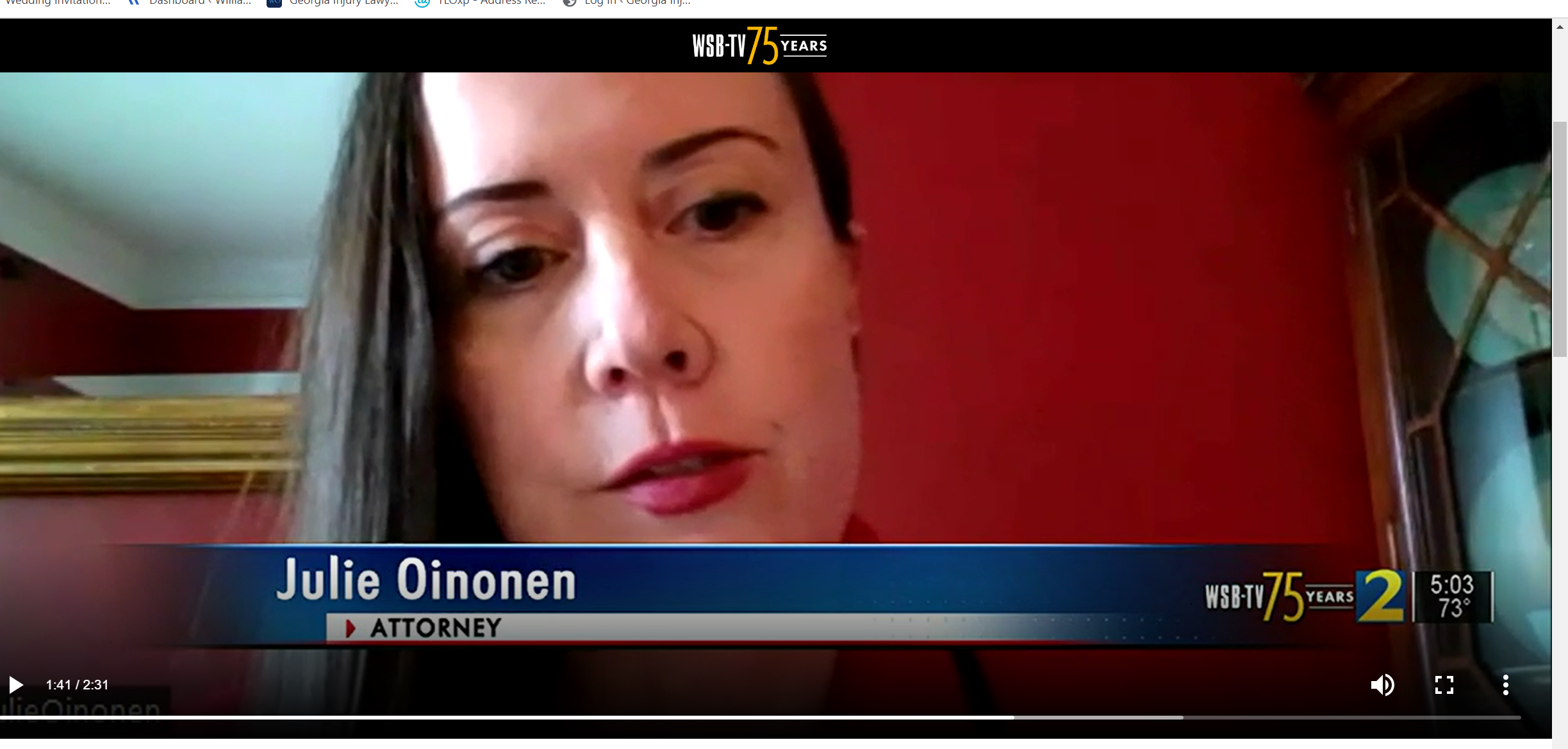
Good Georgia Lawyer was featured on the Channel Two six o' clock news regarding a bullying lawsuit their clients were forced to sue against Clayton County School District for failure to comply with the Georgia Bullying Statute and the Georgia Open Records Act.

In one instance, our clients' daughter was called a "snitch" by her guidance counselor on a bullhorn in front of all of her classmates after she had to file an incident report against her teacher who violently exploded and repeatedly physically assaulted her classmate including using the N word. Two other faculty had to drag the teacher off her classmate to keep him from repeatedly punching him and headbutting him up against a wall. The young girl had to file a report numerous times but not before she was retaliated against by faculty in front of the entire school via a bullhorn in violation of the Georgia bullying statute which prohibits retaliation related to bullying complaints.

In another instance, our clients' son had been a victim of verbal and physical abusive bullying for an entire year with his teacher failing to comply with a bullying action plan which had been set in place in order to protect the child. The situation continued to escalate for the worse with the administration failing to appropriately intervene, require the teacher to comply with the law, and respond to the parents repeated requests for records under the Georgia Open Records Act.

The parents seek injunctive relief from the Court, meaning they request a Judge to order Clayton County School District to comply with the laws and have decided to file this lawsuit in order to address a wide spread pervasive problem of bullying.

This lawsuit was featured on the five o'clock and six o'clock news two nights in a row. To see a video of the teacher hitting the student, click here.

To see what the family had to endure with their young son, you can watch the news feature here.

Williams Oinonen LLC regularly represents students, parents, teachers, and principals in cases against school districts related to employment, non-renewal, disability, discipline, discipline and other education related law issues.

June 7, 2012

Williams Oinonen LLC: The Premiere Opponent Research Political Consulting Team For Election Season


Senator Fort.pngThanks to one of our favorite Politician clients and dear friend Senator Vincent Fort, Williams Oinonen LLC is now the listed political campaign strategy opponent research vendor for the Georgia Democratic Party.

Williams Oinonen LLC also wishes to thank our many friends and clients throughout the years including Tharon Johnson, Kevin Ross, Rep. Rashad Taylor, Mayor Kasim Reed, Rep. Georganna Sinkfield, the Congressman John Lewis team and the many other elected officials to whom we owe a debt of gratitude and friendship.

Williams Oinonen LLC represents CEOs of Counties, Mayors, Senators, State Representatives, Congressmen and other elected officials who call on us particularly during busy campaign season.

Our firm focuses all areas of a political campaign but we pride ourselves most on:

***Conducting opponent research, identifying your competitor's key vulnerabilities, and developing key strategies sure to defeat the opposition.

***Policy and issue research analysis.

***Strategic communications, message creation utilizing creative use of all new media.

***Image marketing.

***Preventative and reactive crisis management.

From one of our clients who said it best:

"Hands down, Williams Oinonen is the best out there. They played a vital role in ensuring a landslide victory. From offering priceless opponent research, to developing key strategies, to providing media and political advice----they are a tenacious and unstoppable pair and are the one "must have" you want on your team. Ethical, honest, and committed, they were always there for me when I needed them. If you are looking to win---call Williams Oinonen."

Whether it is election season or not, call today if you are interested in having us be a part of your team.

May 14, 2012

Good Georgia Education Lawyer Discusses Recent Non-Renewal Contract Letters Sent To Teachers


teacherstudent.JPG

It is that time of year again: a time that can be very difficult for teachers in Georgia who have recently received a letter notifying them that their contract has been non-renewed. As many teachers already know, the law in Georgia protects teachers who are in their fourth year within the same local school district. The law states that once a teacher accepts a school year contract for the fourth consecutive school year from the same local school district, that teacher may not be demoted or non-renewed unless for a set of specific reasons. And if demotion or non-renewal occurs, those teachers are entitled to procedural due process which includes a non-renewal hearing. Good Georgia Lawyer has written extensively about teacher rights so to learn more about your rights to a non-renewal hearing, we recommend you read our article here. Also you can read here. And here as well.

The grounds for suspension or termination are listed in O.C.G.A. § 20-2-940 and include such reasons as: incompetency, insubordination, immorality, willful neglect of duties, inciting students to violate laws, failure to maintain educational training, reduction of staff due to loss of students or cancellation of programs, or any other good and sufficient cause.

Regarding the "reduction of staff" grounds for non-renewal, one small improvement to the law happened during this year's legislative session 2012. As a result of so many teachers facing layoffs due to our difficult economy, legislators added language which states that if non-renewal occurs due to reduction in staff (often known as "Reduction In Force" (RIF) ) due to no fault or performance issue, the local administration must specify in writing "that the termination or suspension is due to no fault or performance issues" of the employee. See: 2012 Georgia Laws Act 707 (S.B. 153).

Regardless of the reason, receiving a non-renewal letter can be a very painful and stressful experience. The important issue is deciding whether or not to choose to exercise your rights to a non-renewal hearing or not. If you are a certified teacher who is in their fourth consecutive year at a local school district, one of your decisions is whether to elect your right to the non-renewal hearing. Before you make your decision as to whether you wish to exercise your rights to such a process, it is important to seek counsel to be certain you are aware of all potential legal options.

Oftentimes, we have clients who have come to us with a certain set of facts and may not be aware that they may have various legal claims in addition to their right to a non-renewal hearing. Before you make such an important decision regarding your professional future, give us a call to obtain the legal advice you deserve.


April 22, 2012

Good Georgia Lawyer Discusses How To Get Attorney Fees


attorney.JPG

"How can I get attorney fees in a lawsuit?" This is a question we often hear from clients. Different Georgia laws govern the recovery of attorney fees in a lawsuit. If the actions of the defendant prior to the litigation were done in bad faith and would be considered "stubbornly litigious," then fees may be assessed pursuant to OCGA 13-6-11.

If during the course of the litigation, the attorneys expanded the litigation beyond reasonable or pursued claims or defenses that had no justiciable issues of law or fact, then a party may recover fees associated with that conduct under OCGA 9-15-14.
And, if a party incurs damages as a result of a lawsuit that are beyond attorney fees, they may have an entirely different and separate cause of action pursuant to OCGA 51-7-80.

Finally, after the trial, sanctions can be awarded for frivolous appeals. As with any of these statutes, the party must prove the attorney fees that were actually incurred, the actions the opposing party did to incur such fees, and whether the fees were reasonable and necessary.

Merely prevailing at summary judgment does not automatically merit an award of attorney's fees. Chong v Reebaa Construction, Inc. 284 Ga. App. 830 (2007). Likewise prevailing in an entire case also does not garner an automatic award of attorney fees either. Glynn Brunsick Mem'l Hosp. Autho. V. Gibbons, 243 Ga. App. 341 (2000). If there is at least an arguable support for the position taken, then an award of fees should not be justified. So long as there is some evidence from which a jury could find for the plaintiff a defense verdict does not warrant imposition of fees. Rental Equip Group LLC v. MACI LLC 263 Ga. App. 155 (2003). An award of attorneys fees is not justified where there is arguable legal support for the position taken.

Nevertheless, under OCGA 9-15-14(a), attorney fees are mandatory where a party has asserted a position where there is a complete absence of any justiciable issue of law or fact that it could not have been reasonably believed that a court would have accepted the position. Cavin v. Brown 246 Ga. App. 40 (2000).

Additionally, under 9-15-14(b), a permissive award of attorney fees and litigation expenses is available if: i. the action brought lacked substantial justification (is substantially frivolous, groundless or vexatious), ii. the action was brought for delay or harassment, or iii. the party or attorney unnecessarily expanded the proceedings by discovery abuse or otherwise.

In order to prevent the chilling of actions that prevent stagnation of law, section c provides that no attorney or party shall be assessed attorney fees in a "good faith attempt to establish a new theory of law in Georgia if such new theory of law is based on some recognized precedential or persuasive authority" which might include dissents, federal cases, cases from other states, and positions taken in law reviews or other legal writings.

Want more information?

Continue reading "Good Georgia Lawyer Discusses How To Get Attorney Fees" »

April 18, 2012

Good Georgia Lawyer Discusses New Open Records And Meetings Act Revisions Signed Into Law Yesterday By Governor


sam.jpg

Yesterday, Sam Olens drafted a memo to all departments, agencies, commission, authorities, councils and boards of the state of Georgia. It was drafted in anticipation of Governor Deal signing HB 397 which substantially revises Georgia's Open Records and Open Meetings Acts. HB 397 became effective immediately upon signature of the Governor yesterday.

Mr. Olens stated in his memo to the state agencies that: "Our goal in preparing and championing this legislation was not to substantially revise Georgia's open government law, but, first and foremost, to put it in terms that laymen and public officials alike can more readily understand. Nonetheless, the Act does make several significant changes to prior law, and I write today to highlight several key changes for your reference."

Those changes were mentioned by Mr. Olens as follows:

THE OPEN MEETINGS ACT

1. The Act simplifies the definition of "meeting" to mean any gathering of a quorum
of an agency's governing body at which "any official business, policy, or public
matter of the agency is formulated, presented, discussed, or voted upon."

2. The Act makes clear that all votes must be taken in public. O,C.G.A.
50-14-l(b). Exceptions exist only for votes to authorize settlement of matters in
litigation and for preliminary votes on real estate transactions. See O.C.G.A.
50-14-3(bXl).

3. The minutes requirements for meetings are clarified to include identifying those
who second motions and to identify those voting for or against proposals and
motions except when the vote is unanimous.

4. Minutes must also be kept of executive sessions, though these are not public.
Their purpose is to resolve disputes should a matter go to court regarding an
executive session.

5. In situations involving emergency conditions or health concerns involving a
member, meetings of agencies without state-wide jurisdiction may take place in
whole or part (depending on the circumstances) by teleconference.

6. Meetings of prosecutorial agencies in the state are now not covered by the Open
Meetings Act. O.C.G.A. 50-14-3(aX3).

7. Email communications between members of an agency's governing board are
now not considered a "meeting" although they remain open records.

8. The real estate exception to the Open Meetings Act has been expanded to cover
the sale, lease, and appraisal of real property,
.
9. The personnel exception to the Open Meetings Act has been expanded to allow
closed session interviews for the heads of agencies. The exception, however, now
clearly does not allow closed discussions regarding an agency's employment or
hiring practices.

10. The Act allows discussion in executive session of portions of records not subject
to public review under the Open Records Act when there do not exist other
reasonable means to protect the privacy of the information involved,

11. The Act provides a clearer rule for handling closed meetings when discussions
veer into an area that should be open.

12. The Act increases the penalty to $ 1,000 for first open meetings violations and to
$2,500 for subsequent violations within a 12 month period. It also allows
imposition of penalties in civil actions for negligent violation of the law.

THE OPEN RECORDS ACT

1. The Act now includes "dala" and"data fields" within the definition of "public
record," and it clarifies the electronic records and data that are subject to the Open
Records Act and the obligations of the agency to provide such material.

2. As in current law, agencies must produce the documents they can within a
reasonable period not to exceed three business days, and when they cannot
produce all of the requested documents in this period they must notify the
requester within this period when the documents will be produced.

3, While the Act still permits both oral and written requests, it allows agencies to
designate an open records officer on whom written requests must be made, and it
gives requesters the option of making requests to the head of the agency or the
senior official at a satellite office of the agency, to a clerk so designated as the
agency record custodian or to an angency designated open records officer.
The Act has provisions for providing adequate notice to the public when it
designates an open records officer.

4. Before seeking to enforce the Act in court a requester is required to make a
written request to the agency.

5. The Act clarifies the fees agencies may impose, The cost per page is now capped
at ten cents for letter sized pages.

6. Agencies now do not have to notify requesters of charges less than $25. In
situations where the estimated costs are between $25 to $500 an agency must
estimate the costs for the requester, but may not insist on prepayment before
allowing a requester to review records. If estimated costs exceed $500 an agency
may insist on prepayment before beginning search and production, If a requester
has not paid the charges for a prior request, an agency may insist on prepayment
for future requests until the payment is macle or the issue resolved.

7. Requests for records by civil litigants for use in ongoing litigation must be copied
to opposing counsel and copies of the records produced likewise must be
produced to the counsel ofrecord for the agency unless said counsel elects not to
receive them.

8. The Act clarifies the information a requester should provide when seeking email.

9. Provisions are made for production of records through websites, and the Act
clarifies how this relates to the production of electronic data.

10. As with the Open Meetings Act, the Act increases the penalty to $ 1,000 for first
open records violations, and to $2,500 for subsequent violations within a 12
month period. It also allows imposition of penalties in civil actions for negligent
non-compliance with the law.

Mr. Olens concluded his memo stating that he intends this only to highlight significant changes in the Open Records and Open Meetings Acts. It is not meant to be exhaustive.

If you believe a public agency is violating your rights under the Georgia Open Records Act, contact Williams Oinonen LLC for more information at 404-654-0288.

April 17, 2012

Good Georgia Business Lawyer Discusses Consumer Protection Under The Georgia Fair Business Practices Act


consumer.JPG

Purpose:

The Georgia Fair Business Practices Act is the primary law that protects consumers in our state from unfair business practices. The actual purpose of the law as cited in O.C.G.A. § 10-1-399(a) is: "to protect consumers and legitimate business enterprises from unfair or deceptive practices in the conduct of any trade or commerce...." This law forbids any "[u]nfair or deceptive acts or practices in the conduct of consumer transactions and consumer acts or practices in trade or commerce...."

Notice Requirement and Statute of Limitations:

Any person injured as a result of acts or practices in violation of the Act may bring a private lawsuit for damages (money) upon giving 30 days' written notice. A claim pursuant to the FBPA must be brought within two years after the plaintiff knew or should have known of the alleged violation.

Who The Law Protects:

The FBPA is Georgia's primary law for consumer protection and since its enactment has been increasingly used as a tool to protect injured consumers. It does not apply to deceptive unfair practices occurring in private, it must be applied solely to consumers in order to protect the public from acts that have the potential to harm all Georgia consumers.

Damages Awarded:

Under the Georgia Fair Business Practices Act, O.C.G.A. § 10-1-399(a), any person who suffers injury or damages as a result of consumer acts or practices may bring a lawsuit and recover both general and punitive damages. Punitive damages are awarded in cases of intentional acts.

Additionally under the Georgia Fair Business Practices Act ("the FBPA") treble or "triple" damages are authorized for intentional violations of the law as well as attorney's fees and the cost of litigation. Civil penalties may also be imposed.

Recently, Williams Oinonen LLC sued a Fortune 500 company for violating the Georgia Fair Business Practices Act against a military veteran. The FBPA was the most powerful tool in obtaining justice for our client in that case. Fortunately, because of the FBPA there is more incentive to keep Georgia consumers safe and accountability when unfair business practices occur. To speak to an attorney about a potential Fair Business Practices Act violation or other business dispute, contact Williams Oinonen LLC at 404-654-0288.

April 16, 2012

Williams Oinonen LLC Hosts Covenant College Pre-Law Students For Day Long Legal Field Trip & Tour Of Emory Law School


IMG_0040.JPGThis past Friday Williams Oinonen LLC hosted a group of pre-law students from Covenant College for an all day excursion. Students left at 6 a.m. from Lookout Mountain, Georgia to arrive at the downtown law office in Atlanta that morning to meet Ms. Oinonen, an attorney at Williams Oinonen LLC who led the day trip.

The day started out with a visit to Emory University School of Law. The group arrived at Emory University around 9:15 a.m. to do a brief walking tour of the larger university campus as a whole and ended up at the law school building. They started the visit by attending an admissions presentation in the Emory Law School Courtroom and then participated in a student led tour of the law school itself. Afterwards, they attended a property class taught by Professor Frank Alexander which according to students was the best part of their visit at Emory. His lecture focused on the constitutional issues surrounding eminent domain. Prior to saying goodbye, they were introduced to the Dean of Admissions, Ethan Rosenzweig 02L

After the Emory Law School tour, the group travelled to the Commerce Club, of which Ms. Oinonen is a member to attend a special private luncheon. During this time, she listened to all of the students share stories of their time at Covenant College and answered questions about law school and the legal profession.

After the luncheon, the group took a tour of Fulton County Courthouse. After the tour, they were able to observe a felony child molestation trial and got to watch the criminal defense attorney give closing argument before the jury in the courtroom of Judge Kimberly Esmond Adams of the Fulton Superior Court.

An alumna of both Covenant College and Emory University School of Law, Ms. Oinonen is currently a Fellow at Emory University School of Law's Center for Advocacy and Dispute Resolution, adjunct faculty member at the Trial Techniques Program and an alumni advisor at the Tort and Insurance Society Practice Group for Emory Law students. Her practice primarily focuses on helping plaintiffs injured or harmed due to a wrong or injustice specifically in employment matters, education, and personal injury cases. She recently stated: "Some of the best part of my law practice is when I have the chance to work with young people at Covenant College and Emory University School of Law. There is no better way to give back then helping others and the students at Covenant and Emory are a joy and pleasure to work with."

April 6, 2012

Good Georgia Lawyer Wishes You Chag Sameach This Passover and a Good Friday, Happy Easter


easter.jpg

Good Georgia Lawyer wishes Chag Sameach to all our Jewish friends this Passover.

We also wish a Good Friday and Happy Easter to all who celebrate the resurrection of our Lord and Savior Jesus Christ this Sunday.

For all people, it is a good time to reflect on the newness and re-birth of the season this spring.

The lawyers at Williams Oinonen LLC are privileged to represent Georgians of all religious and non-religious persuasions. We are committed to helping people from a diverse range of various cultural backgrounds obtain the justice they deserve by exercising their Constitutional rights to the civil justice system as preserved in our Seventh Amendment.

April 5, 2012

Good Georgia Education & Employment Lawyer Needed During Non-Renewal of Teacher Contracts, PDP's, and Terminations:


teacherstudent.JPG

It's that time of year again, when sadly, many good teachers start to worry whether their principal or school administrator will issue them a non-renewal letter regarding their teaching contract. This can often happen if the teacher has been previously placed on a Professional Development Plan, or "PDP."

One of the biggest way principals or school districts lay the groundwork in order to try and fire a tenured teacher is by putting them on a PDP early on in the school year. Laying the "paper trail" even when the accusations against the teachers are not legitimate, is the most effective legal strategy that school districts use to try and ensure that future adverse employment action against the teacher is deemed legal and fair.

One administrator estimates that 50% of the teachers placed on a Professional Development Plan ("PDP") are successful in completing it. School administrators know this 'game' when they place the teacher on a PDP. Oftentimes the end purpose is not to improve the teacher's performance, but rather simply to have legal justification for firing the tenured teacher down the road. To do this successfully, some teachers end up being set up for failure by being placed in a no-win situation.

If you are a tenured teacher who has been placed on a PDP, it is vital that you immediately seek competent, legal counsel in order to begin to fight the one-sided paper trail that will be used to justify non-renewal of your teaching contract from day one.

It is also important to educate yourself on your legal rights as a Georgia teacher. For example, if a school board terminates, suspends, or demotes a teacher in the middle of a contract year, the teacher has a right to be represented by counsel during a hearing - even if the teacher is not tenured (O.C.G.A. 20-2-940). If a school board attempts to non-renew a tenured teacher's contract, the teacher again has a right to a non-renewal hearing. (O.C.G.A. 20-2-942).

Good Georgia Lawyer has written about the rights of teachers relating to employment termination and contract non renewal which we recommend you read here and here.

The important thing is to act sooner rather than later if you are a teacher facing a potential adverse employment action. All too often, human beings procrastinate rather than dealing with the scary things in life that we don't want to have to face such as the loss of a job in this difficult economy. As a result, clients are oftentimes calling us after the fact rather then early on when it is much easier to help them.

Don't end up in a case of too little, too late. The sooner an attorney is on your side, the better the chance your employment as a teacher in a challenging work environment will have a successful outcome.

Continue reading "Good Georgia Education & Employment Lawyer Needed During Non-Renewal of Teacher Contracts, PDP's, and Terminations:" »

March 25, 2012

When Do You Need A Lawyer For Bedbugs? Understanding Bedbug Lawsuits In Georgia


bed bug.jpg How do you know if you have valid legal claim for bed bug injuries in Georgia?:

In Georgia, it is important to show that the property owner was negligent. One example to show negligence would be if a hotel owner, when being put on notice of a dangerous condition (a bed bug infestation), failed to respond properly, thus subjecting tenants or hotel guests to the danger which caused their damages, i.e. injuries, property loss, medical bills.

What does the law say about bed bugs in Georgia hotels? The "duty of an innkeeper is well settled in Georgia as the duty to exercise ordinary care to afford guests premises that are reasonably safe for use and occupancy." Hotel Richmond, Inc. v. Wilkinson, 73 Ga. App. 36, 41 (35 SE2d 536). Furthermore, the innkeeper has a duty to inspect and is liable for such injuries caused by defects as would be disclosed by a reasonable inspection. Hillinghorst v. Heart of Atlanta Motel, 104 Ga. App. 731.

The following are some of the various legal claims a Plaintiff may bring against a negligent hotel owner as a result of bed bug injuries:

Negligence: To prove negligence against a Defendant such as a hotel, the Plaintiffs need to show that the Defendants negligently breached their duty by failing to exercise ordinary care to provide them rooms that were reasonably safe for use and occupancy and that failure caused the Plaintiffs injuries.

Negligence Per Se: Under O.C.G.A. § 51-3-1, it is the duty of an owner who by express or implied invitation induces others to come upon his premises for lawful purpose, he is liable in damages to such persons for injuries caused by his failure to exercise ordinary care in keeping the premises safe. Additionally, under Georgia State Regulation 290-5-18-.11 of the Department of Human Resources, owners are required to utilize effective measures to eliminate insects from their hotel's premises.

Consequently, in a negligence per se claim against a hotel, Plaintiffs can show that Defendants violated O.C.G.A. § 51-3-1 by inviting guests to stay at their hotel property and failing to exercise ordinary care to keep their hotel premises safe. Additionally, Plaintiffs might also be able to prove that Defendants violated Georgia State Regulation 290-5-18-.11 by failing to utilize effective measures to eliminate the bedbug infestation from their premises while subjecting their hotel guests to these dangerous conditions. If Defendants violate these laws, they are liable for the harms their actions caused to the Plaintiffs.

Georgia Fair Business Practices Act: Furthermore, Plaintiffs as members of the consuming public may be able to file a Georgia Fair Business Practices Act claim if they can show the Defendant engaged in unfair and/or deceptive business practices and that Plaintiffs justifiably relied on Defendant's knowing, false representations that caused the Plaintiffs damages.

If Defendant has committed several unfair and/or deceptive practices, Plaintiffs may be entitled to both general and exemplary damages, as well as being entitled to treble (triple) damages because Defendant intentional violated the Georgia Fair Business Practices Act. See Conseco Finance Servicing Corporation v. Hill, 252 Ga. App 774 (2001). Prior to a Fair Business practices claim being filed, a 30 day written notice of demand must be made. Under Georgia law this notice is to be liberally construed. See Lynas v. Williams, 216 Ga. App. 434, 435 (1995).

Punitives claim: Plaintiffs can also argue that they are entitled to exemplary damages if Defendants' conduct was wanton, willful, and showed a reckless disregard and deliberate indifference to the rights of the Plaintiffs.

Claim for Attorneys Fees: Additionally, if Defendants have been stubbornly litigious, acted in manifest bad faith and caused Plaintiffs unnecessary trouble and expense, Plaintiffs may ask that the court should grant Attorney Fees.

For helpful photographs on identifying bed bugs, see here. Additionally, the United States Environmental Protection Agency helpful website which covers frequently asked questions can be, seen here. Bedbug Central, a website devoted to helpful bed bug advice can be seen here.

Continue reading "When Do You Need A Lawyer For Bedbugs? Understanding Bedbug Lawsuits In Georgia" »